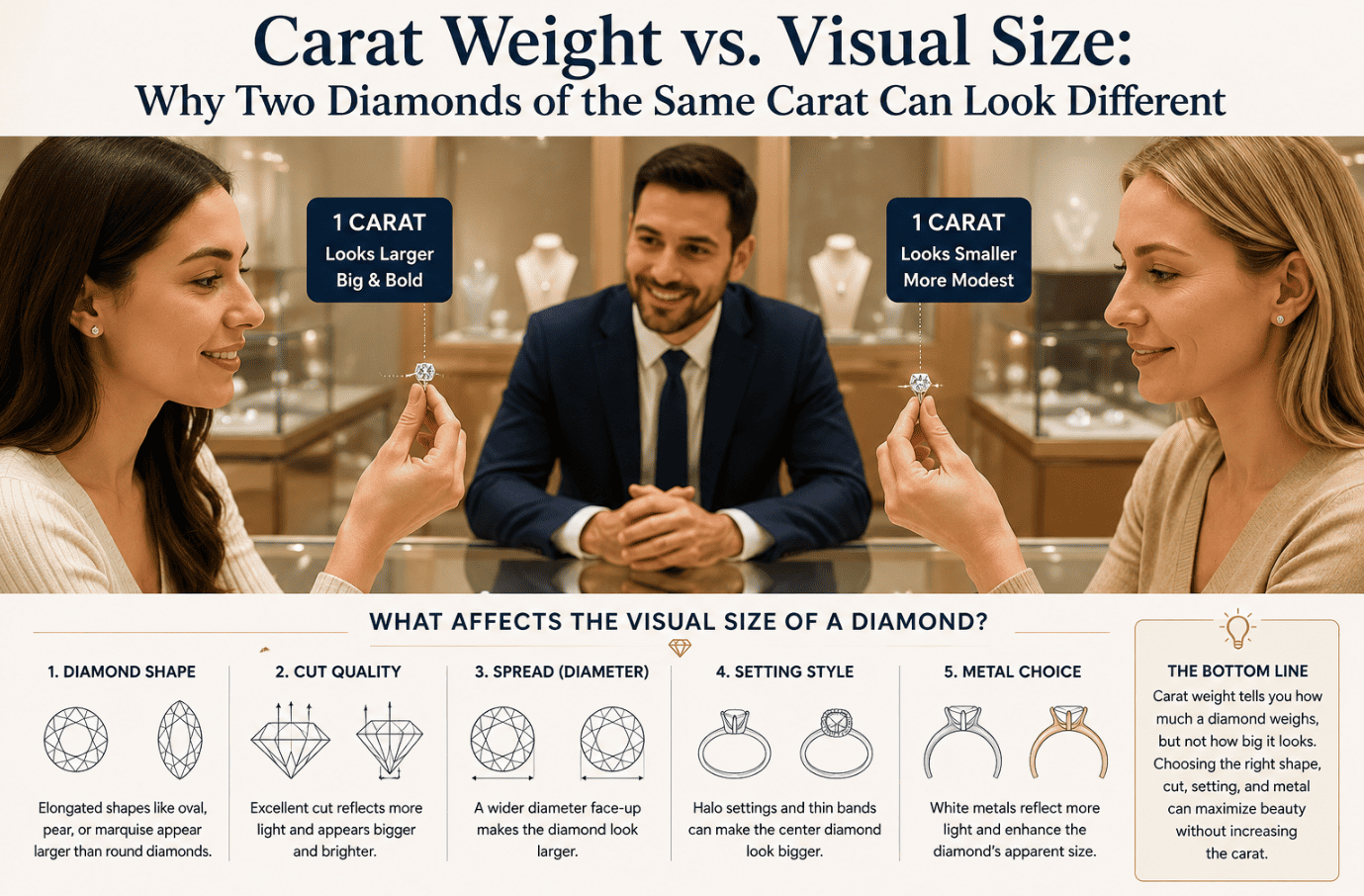

Picture this: two customers walk into a jewelry store, each holding a 1-carat diamond ring. One diamond looks like it’s practically glowing off the finger, big and bold. The other? Perfectly lovely, but noticeably more modest. Same carat weight. Same price bracket, roughly. So what’s going on?
If you’ve ever wondered about the price difference, you’re not alone. Many people are confused when shopping for a diamond, whether it’s for an engagement ring, an heirloom, or a vintage piece. This is a common question, and understanding the answer can help you shop smarter. If you’re looking for practical tips to choose the right diamond, this guide will give you clear advice to make your next purchase easier.
The simple truth is that carat weight only measures how much a diamond weighs, not how large it appears.
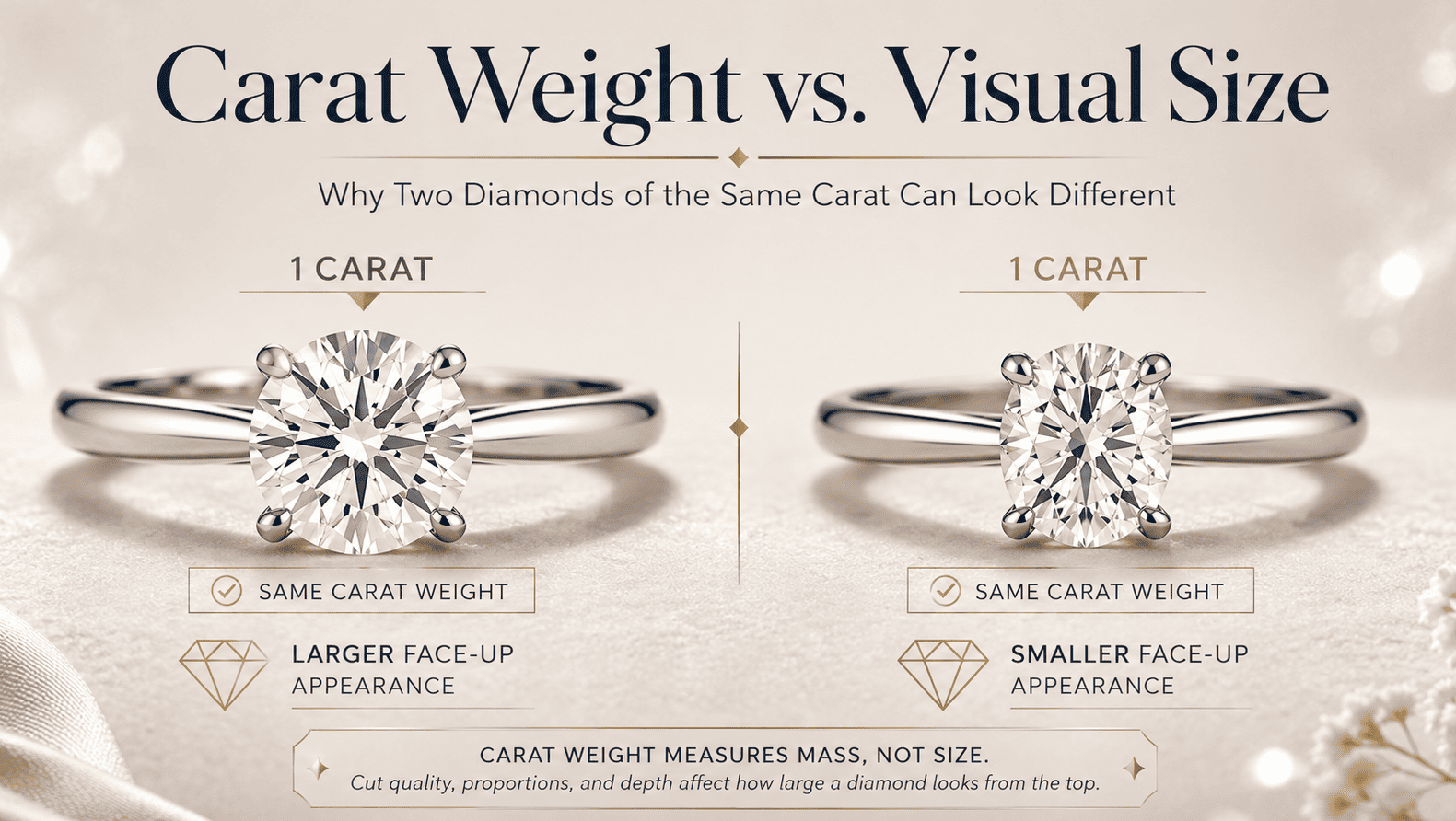
A carat is simply a unit of mass. One carat equals 200 milligrams. It does not relate to the diamond’s width, depth, or how much space it covers on your finger. Two diamonds can weigh the same but look entirely unique in size, which jewelers call “spread.”
This concept can be confusing because it’s easy to assume a higher carat means a bigger stone. However, carat is a weight measurement, while size is what you see. Understanding the difference makes things much clearer.
If carat alone doesn’t determine size, what does? The main factors are cut, shape, and setting. Cut is the most important, so we’ll start there.
This is where it gets interesting. When shaping a rough diamond, the cutter must decide how deep to cut the stone.
If a diamond is cut deep, much of its weight is hidden in the pavilion, the pointed bottom half that sits below the setting and can’t be seen when the ring is worn. The carat weight is real, but it’s not visible. A deep-cut 1-carat diamond might look more like a 0.85-carat stone to the eye.
If a diamond is cut shallower and wider, more of its weight is spread across the top, which is the visible part. This makes the stone look noticeably larger for the same carat weight.
This explains why two 1-carat diamonds placed side by side can have a noticeable difference in diameter, sometimes by more than a millimeter. It’s not an illusion; it’s the result of how each stone was cut.

Shape is another important factor. Some cuts naturally look larger per carat than others.
Elongated shapes such as ovals, marquise, pear, and emerald cuts often look bigger for their weight because they cover more of your finger. Round brilliants, which are the most popular and sparkly, tend to look a bit smaller per carat since more of their mass is in the depth, which enhances their brilliance. Cushion and princess cuts fall in between these two categories.
If visual impact is more important to you than a specific shape, keep this fact in mind before you buy.
The setting of a diamond also makes a big difference. For example, a halo setting surrounds the center stone with smaller diamonds, making it look much bigger without adding carat weight. Bezel settings vary: a wide metal rim can make the stone look larger, while a tighter design can make it appear smaller and more contained. Simple prong settings display the diamond as it is, with no added effects.
Many people ask about the difference, and it’s a good question. Natural and lab-grown diamond rings now look almost identical, at least to the untrained eye. Does the origin affect how big a diamond looks?
Not at all. Lab-grown diamonds have the same crystal structure, density, and optical properties as natural diamonds. A 1-carat lab-grown stone and a 1-carat natural stone, cut to the same proportions and shape, will look exactly the same in size. There is no visual advantage or disadvantage based on origin.
The main difference is price. Lab-grown diamonds usually cost less per carat, so buyers can often get a bigger stone or a better cut for the same price as a natural diamond. If you care more about size and sparkle than rarity or origin, lab-grown diamonds are a wonderful option.
If you have a set budget, focus on your priorities. Cut is usually the most important factor for beauty. A well-cut diamond can look brighter and more impressive than a larger one with a poor cut. Once you find a cut that reflects light well, balance carat weight and shape to match your taste. For example, an elongated shape like an oval or emerald can make your diamond look bigger for the same carat, while a classic round brilliant offers the most sparkle, even if it appears a bit smaller. Decide what matters most to you, and put your budget toward cut first, then size and shape, for the best value.
If you’re looking at antique or estate jewelry, natural diamonds are still the standard. Older cutting styles like old mine cuts and old European cuts have different proportions than modern stones. They are often deeper and look smaller per carat by today’s standards, but their proportions give them a soft, romantic glow and unique vintage charm.
Ask for the actual measurements, not just the carat weight. The millimeter diameter gives you a much better idea of how a diamond will look on your hand.
Carat weight is just one detail on a diamond’s report, not the whole story. Cut, shape, setting, and whether a stone is natural or lab-grown all affect how big a diamond looks on your finger. Smart buyers look beyond the carat number and consider the full picture, since a well-cut, well-proportioned diamond will always look better than a heavier one with a poor cut.
Whether you’re buying your first ring, selling a piece from your jewelry box, or just curious about a diamond you own, knowing how carat weight and visual size relate is one of the most useful things to understand before making a decision.
For more info, visit our official website: www.antiquediamondbuyers.org
To help our team evaluate your item quickly, please submit your details through our online form.
Submit Your ItemStart by creating your account.
After submission, our experts will review your item and contact you with the next steps.